
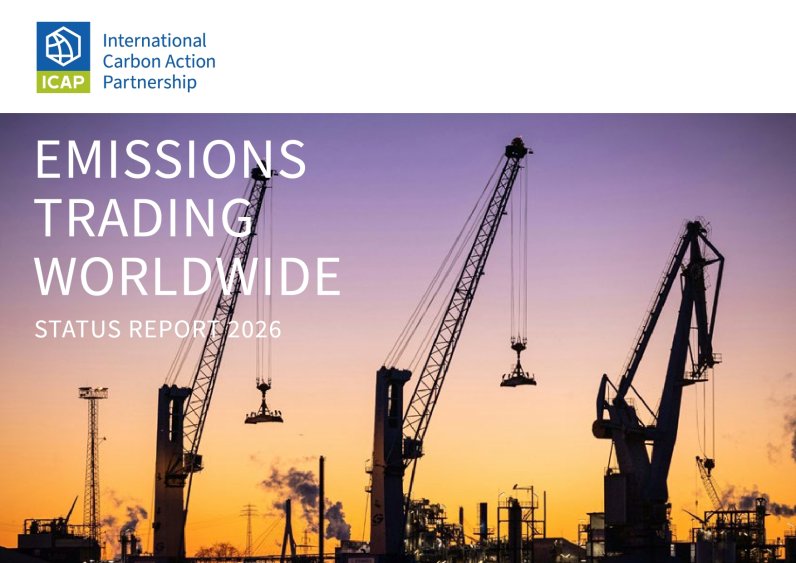
Emissions Trading Worldwide: ICAP Status Report 2026

Category
Topics
Release date
Language
OUT NOW: ICAP Status Report 2026
Despite a turbulent geopolitical landscape and renewed pressures on energy markets, global emissions trading continues to expand and mature, becoming now firmly established at the center of global climate policy. Three new national systems are launching in 2026, established systems are deepening their ambition, and record revenues are being put to work for clean energy transitions and household support.
- 41 emissions trading systems (ETS) are now in force worldwide, covering 26% of global GHG emissions
- Three new national-level systems launching in 2026 — Japan, India, and Vietnam — with more in the pipeline, reflecting the spread of emissions trading across diverse economies and development contexts
- ETS revenues reached a new record of nearly USD 80 billion in 2025, equipping governments to drive clean energy transitions and support affected households
- An ETS is now in place in 14 of the G20 nations — and several have named it as a central instrument for NDC 3.0 delivery under the Paris Agreement
- Jurisdictions operating an ETS together account for 63% of global GDP and more than half the world’s population — placing carbon markets at the centre of the global economy
- International cooperation is deepening — with new cross-jurisdictional dialogue platforms and a growing shared understanding of good practice
A growing and maturing global carbon market
Emissions trading has moved decisively from niche to mainstream — and today’s expansion is being driven primarily by large and middle-income emerging economies, particularly across Asia and Latin America. India and Vietnam are launching national systems this year, while Japan — having run a voluntary scheme for several years — is now bringing a mandatory national system online. In Latin America, Brazil, Chile, and Colombia have passed ETS legislation and are preparing for implementation, while on Europe’s doorstep, Türkiye is completing the final preparations for its pilot system. Beyond the 41 systems already in force, a further 16 are at various stages of development or consideration worldwide. Many are looking to adopt intensity-based designs and hybrid frameworks that bring together ETS, offset crediting, and carbon taxes within a single, coherent policy architecture — each tailored to domestic contexts and objectives.
At the same time, established systems are evolving with renewed ambition. China has issued landmark guidelines to transition its national ETS to an absolute cap by 2027 and progressively expand coverage to all major industrial emitters; Korea has entered a stronger new phase with greater auctioning and a new market stability reserve; California has legislated its system through to 2045; and the EU is preparing to launch ETS 2 — covering buildings and road transport — in 2028. Alongside these reforms, the EU’s CBAM has entered its compliance phase — and the UK is following suit — acting as a catalyst for broader carbon pricing ambitions in trading partner countries, while also prompting established systems to rethink the long-term future of free allocation. With an ETS in force in 14 of the G20 nations, and many countries naming it as a central instrument for NDC 3.0 delivery under the Paris Agreement, carbon markets sit firmly at the center of decarbonization strategies in the world’s leading economies.
Built to last: resilience, revenues, and the road to net-zero
The resilience of emissions trading in the face of political and economic turbulence is no accident — it is the product of deliberate design. Hard-won lessons are now actively shaping how systems are built: embedding robust legislative processes, anchoring ETS within overarching climate laws and net-zero targets, and developing integrated policy frameworks that give carbon markets the durability to outlast political cycles. Record revenues of nearly USD 80 billion in 2025 are equipping governments to drive clean energy transitions and support affected households — strengthening both the effectiveness and the long-term political viability of carbon pricing. As carbon markets multiply across diverse jurisdictions the risk of fragmentation grows — making international cooperation ever more essential. Around the world, governments are responding: new dialogue platforms are emerging and a growing shared understanding of good practice is helping to build the global coherence that is increasingly needed.
Stefano De Clara

What strikes me most about this year’s report is not just how far emissions trading has come — it is where it is going. Governments are not just holding course — they are embedding carbon markets at the heart of their international climate commitments. Emissions trading is no longer a niche policy tool. It is becoming the architecture of the global climate response.
To view and download the full report, please click here. Executive summaries in English, Spanish, French, and Chinese will be available shortly after launch.
To learn more about the ICAP Secretariat and stay up-to-date with current publications and events, please visit our website, subscribe to our quarterly newsletter, and follow us on LinkedIn.
For media enquiries, please contact: anna-charlotte [dot] wenzel icapcarbonaction [dot] com (anna-charlotte[dot]wenzel[at]icapcarbonaction[dot]com)

