
International Carbon Action Partnership (ICAP)

News
Explore our latest news covering emissions trading systems worldwide and what’s happening at ICAP.
See all news

Japan transitions its GX-ETS to the mandatory phase

Virginia enacts legislation to rejoin RGGI

Compliance obligations under India's Carbon Credit Trading Scheme enter into force for seven sectors

Japan transitions its GX-ETS to the mandatory phase
Virginia enacts legislation to rejoin RGGI
Compliance obligations under India's Carbon Credit Trading Scheme enter into force for seven sectors
Explore our tools
Allowance Price Explorer


Featured Publications

Scope Expansion of ETS: Design and Policy Challenges
Emissions trading systems (ETSs) are increasingly recognized as a central instrument in jurisdictions' efforts to meet more ambitious climate targets. As the coverage of existing ETSs continues to grow and new systems are established, policy makers, researchers, and industry experts are turning their attention to the opportunities and challenges of expanding ETS scope, whether by broadening coverage to new sectors, fuels, or gases, or by...

Compensating and Supporting Citizens for Higher Energy Prices due to Carbon Pricing
As carbon pricing becomes more salient for households, especially with the launch of EU ETS 2 for buildings and road transport in the EU, protecting vulnerable citizens remains essential to fairness, social acceptance, and the durability of carbon pricing. This Thematic Brief samples and describes selected citizen-facing measures that compensate for, or support households in avoiding, higher energy costs due to carbon pricing.

Inclusion of Carbon Dioxide Removals in Selected ETS: State of Play
Including carbon dioxide removals (CDR) in emissions trading systems (ETSs) is gaining policy attention. This Thematic Brief surveys current practices across selected ETSs and compiles comparative tables on: eligibility and geography, relationship to ETS scope, legal tender, and quantitative limits; and reversal/permanence provisions (liability, buffer pools, discounting, monitoring periods, tonne‑year variants).
Emissions Trading Worldwide: ICAP Status Report 2025
Check out the 2025 ICAP Status Report with the latest developments in emissions trading around the world.
The report includes:
🔹 State and outlook of emissions trading worldwide
🔹 Detailed factsheets on every system in operation, under development, and under consideration
🔹 Infographics that visualize the systems' characteristics

ETS, Reloaded? Designing Emissions Trading for Net-Zero and Net-Negative Societies
Emissions trading systems (ETSs) play an important part in many jurisdictions’ mitigation strategies, but their role and design are likely to change over the decades to come. Achieving net-zero emissions by mid-century or soon thereafter is essential to keep global temperatures at safe levels. Consequently, multiple jurisdictions have adopted climate neutrality targets by around mid-century . ETSs can play a central role in this process and have...
Carbon Pricing in the Power Sector: Role and design for transitioning toward net-zero carbon development
This report delves deep into the power sector value chain dynamics, demonstrating how well-designed carbon pricing instruments can be instrumental in helping countries reach their decarbonization goals. Focusing on how decisions are made in diverse power sector models in several developing countries, this report establishes that the CPI must be carefully positioned at the right regulation point in the power sector’s value chain—rather than merely...
Applying Rules under Article 6 of the Paris Agreement to Linked Emissions Trading Systems
This paper explores how the Article 6.2 rules agreed at COP26 could be applied to an international link of two ETSs, including how to account for the changes in emissions, addressing the challenges in determining when changes in emissions occur within an ETS, and options to generate finance for adaptation and “net” mitigation from the link.

Emissions Trading and Carbon Capture and Storage: Mapping possible interactions, technical considerations, and existing provisions
This report explores how CCS is treated in different ETSs around the world; if and how ETSs could play a role in incentivizing the development and deployment of CCS applications; and the challenges and opportunities in developing the required regulation in this context.
Offset Use Across Emissions Trading Systems
As market-based instruments, emissions trading systems are inherently flexible, as entities can decide to reduce their own emissions or buy emissions allowances from the market. Carbon offsets (or simply ‘offsets’) are a tool to further increase flexibility in reaching climate targets under ETSs, as they offer sectoral and geographical flexibility for jurisdictions to reduce greenhouse gas emissions outside of the scope of their ETS. This report...
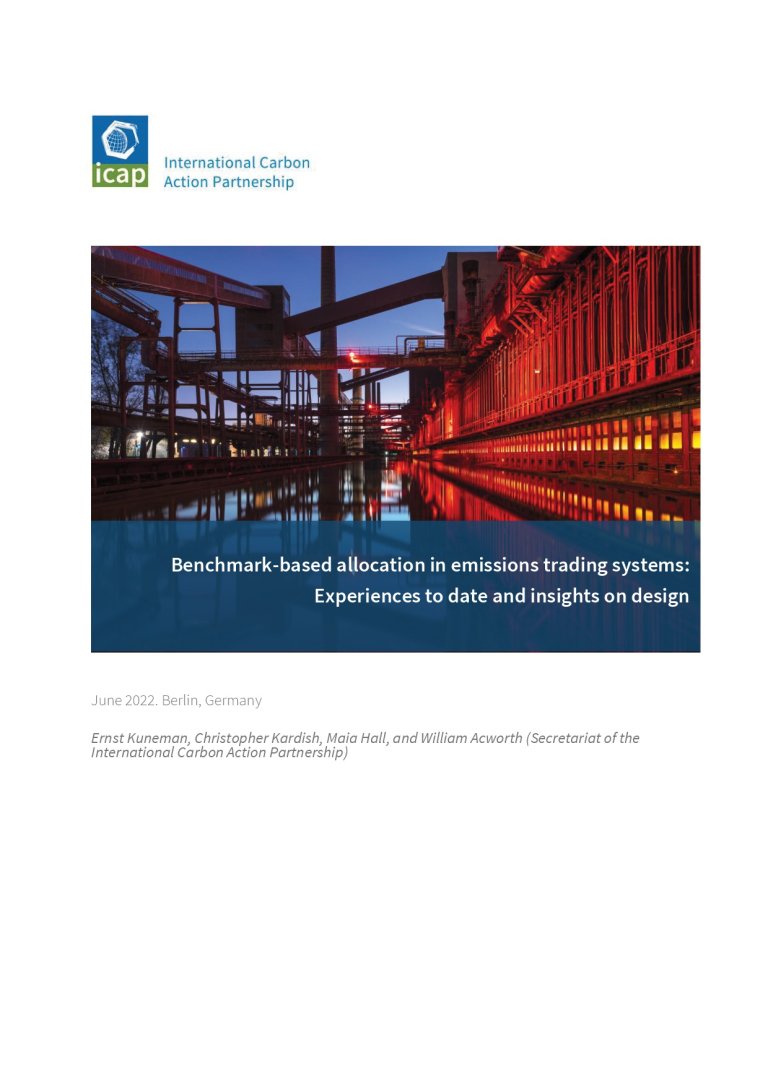
Benchmark-based allocation in emissions trading systems: Experiences to date and insights on design
Benchmarking can protect against carbon leakage while setting incentives to reduce emissions, but their design entails complex trade-offs. This paper explores benchmark-based industrial allocation design and experiences, using insights from existing ETSs, and their implications for abatement and low-carbon investment incentives.